

Program Aims to Advance Minimally Invasive Treatment of Enlarged Prostate
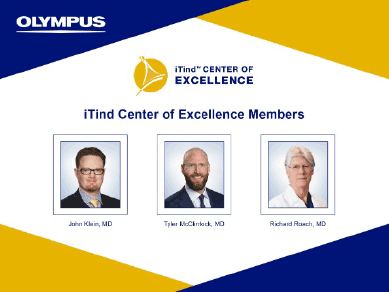
CENTER VALLEY, Pa., (Sept. 9, 2026) – Olympus Corp. of the Americas (Olympus) is pleased to announce the newest members of the iTind™ Center of Excellence (COE) Program, which is designed to enhance care, experience and outcomes for men suffering from symptoms associated with benign prostatic hyperplasia (BPH), known as enlarged prostate.
The iTind Center of Excellence Program welcomes: John Klein, MD, a board-certified urologist with Potomac Urology; Tyler McClintock, MD, a board-certified urologist with Midtown Urology Associates; and Richard Roach, MD, a board-certified urologist with Advanced Urology Institute.
Urologists included in the iTind Center of Excellence Program achieve a required level of training with the iTind procedure, are experienced with the iTind procedure, and demonstrate a high level of commitment to caring for their BPH patients.
Members of the program must undergo an annual re-certification to maintain iTind Center of Excellence status. Olympus also announced the re-certifications of C. Cragin Anderson, MD, FACS, a board-certified urologist with Colorado Urology; and Petar Bajic, MD, a board-certified urologist and Director of Men's Health at Glickman Urological Institute, Cleveland Clinic.
“During National Prostate Health Month in September, we are excited to welcome the newest members of the iTind Center of Excellence Program,” said Matt Woodward, Vice President and Regional Business Lead for Urology at Olympus. “BPH is a common condition that can affect as many as 50 percent of men in their fifties,1 causing symptoms that can disrupt the quality of life for men and their loved ones. It’s important that patients suffering from an enlarged prostate know they have a safe and effective minimally invasive treatment option. Our relationship with these physicians is centered on excellence in patient care and experience and aimed towards improving patient outcomes in BPH treatment.”
Benchmarks for achieving an iTind Center of Excellence status for a urologist treating patients with the iTind procedure include, but are not limited to:
- Completing a specialized iTind training program;
- Upholding clinical proficiency by performing a minimum number of cases annually; and
- Providing de-identified patient data showing a mean improvement score based on FDA guidance for BPH treatments.
Visit the iTind Physician Finder to find physicians who treat BPH with the iTind procedure.
About the iTind™ Procedure
Treatment of lower urinary tract symptoms secondary to BPH using the iTind procedure is straightforward and provides rapid symptom relief in the majority of patients.2,3
- The minimally invasive iTind procedure involves the placement and removal of a temporarily implanted nitinol device.
- This treatment option does not involve cutting or removing tissue and can be performed in an office or as an outpatient hospital procedure, under general or local anesthesia.
- Patients typically return home the same day and routinely do not require a catheter.2
- Clinical studies have shown that the iTind procedure preserves both sexual and ejaculatory function.2,4
For patients who prefer a non-pharmaceutical approach to treating their BPH symptoms or are not yet ready for surgery, the iTind procedure may be well suited to become a first-line treatment.2
The iTind procedure is intended for the treatment of symptoms due to urinary outflow obstruction secondary to benign prostatic hyperplasia (BPH) in men age 50 and above. Implantation of the iTind device may cause pelvic discomfort, blood in urine, painful or urgent urination. In rare cases, the iTind device may cause urinary tract infection or a sudden difficulty to urinate.
Visit the iTind Procedure webpage for more information.
# # #
About Olympus
At Olympus, we are committed to Our Purpose of making people’s lives healthier, safer and more fulfilling. As a global medical technology company, we partner with healthcare professionals to provide solutions and services for early detection, diagnosis and minimally invasive treatment, aiming to improve patient outcomes by elevating the standard of care in targeted disease states.
Olympus Corporation of the Americas, a wholly owned subsidiary of Olympus Corporation, is headquartered in Center Valley, Pennsylvania, USA, and employs more than 4,500 employees throughout locations in North and South America. For more information, visit olympusamerica.com.
1 Urology Care Foundation, “Did You Know: BPH is More Common Than You Think and Can be Easily Treated?”
2 Amparore, Daniele, et al. “3-Year Results Following Treatment with the Second Generation of the Temporary Implantable Nitinol Device in Men with Luts Secondary to Benign Prostatic Obstruction.” Prostate Cancer and Prostatic Diseases, vol. 24, no. 2, 2020, pp. 349–357. doi.org/10.1038/s41391-020-00281-5.
3 Chughtai, Bilal, et al. “The ITIND Temporarily Implanted Nitinol Device for the Treatment of Lower Urinary Tract Symptoms Secondary to Benign Prostatic Hyperplasia: A Multicenter, Randomized, Controlled Trial.” Urology, vol. 153, 2021, pp. 270–276. doi:10.1016/j.urology.2020.12.022.
4 De Nunzio C, Cantiello F, Fiori C, et al. Urinary and sexual function after treatment with temporary implantable nitinol device (iTind) in men with LUTS: 6-month interim results of the MT-06-study. World J Urol. 2021;39(6):2037-2042. doi:10.1007/s00345-020-03418-2